
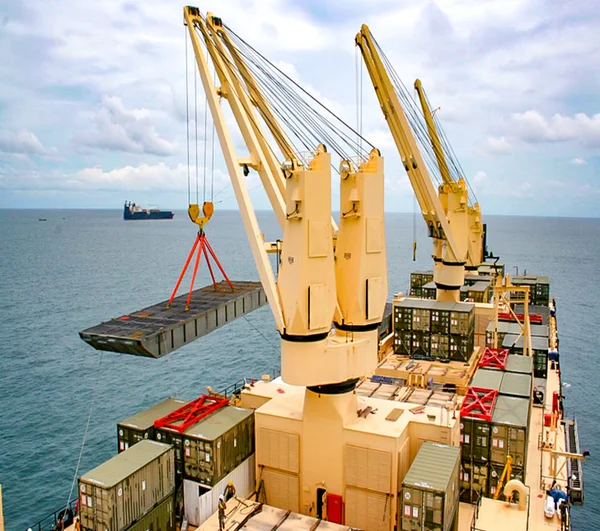
Steel wire ropes in deck cranes – durability that works at sea
Deck cranes are key handling devices used on cargo vessels, offshore units, and in port terminals. Operating in demanding marine conditions, they must work reliably regardless of the weather or the intensity of use. In this system, one of the most important components is the steel wire rope, which is responsible for lifting, lowering, and the safe handling of loads.
Requirements for ropes used in deck cranes
Working at sea is a challenge—not only for operators, but also for technical components. Steel wire ropes used in deck cranes must withstand:
- constant exposure to sea salt and moisture,
- changing temperatures and strong winds,
- high-intensity operation in short cycles,
- dynamic loads and varying working angles.
That’s why deck cranes use specialized corrosion-resistant ropes with increased bending resistance, low working elongation, and long fatigue service life.
What ropes are used in deck cranes?
- Main hoist rope – the most important element of the lifting system. It must be very strong and resistant to abrasion, corrosion, and repeated bending over sheaves. Galvanized, hot-dip galvanized, or additionally lubricated ropes are often used.
- Auxiliary / emergency rope – used in emergency situations or for handling lighter loads. Its selection must also match the crane’s parameters and the expected working conditions.
- Stabilizing ropes – used to reduce load sway on the hook, especially when operating on a moving vessel and in strong winds.
Rope selection – by specification or by manufacturer
For deck cranes, compliance with the following is crucial:
📄 the crane’s technical and operational documentation (DTR),
🏷 the crane manufacturer’s guidelines,
🛠 industry standards (e.g., ISO 4309, EN 12385).
Many users choose proven ropes from the same manufacturers, maintaining operational consistency and assured quality. For well-informed customers, selecting equivalent alternatives is also possible—provided they meet the required technical and corrosion-resistance parameters.
What should you look for when choosing a rope for a deck crane?
✔ Rope construction – resistant to rotation and abrasion,
✔ additional anti-corrosion protection,
✔ compatibility with drum diameter and sheave radius,
✔ quality certificates and technical test documentation.

